Organic Italian Lemon Essential Oil (Citrus limonum) — Cold Pressed, 15 ml
- Regular Price
- $ 16.99
- Sale Price
- $ 16.99
- Regular Price
Sold Out
- Unit Price
- per
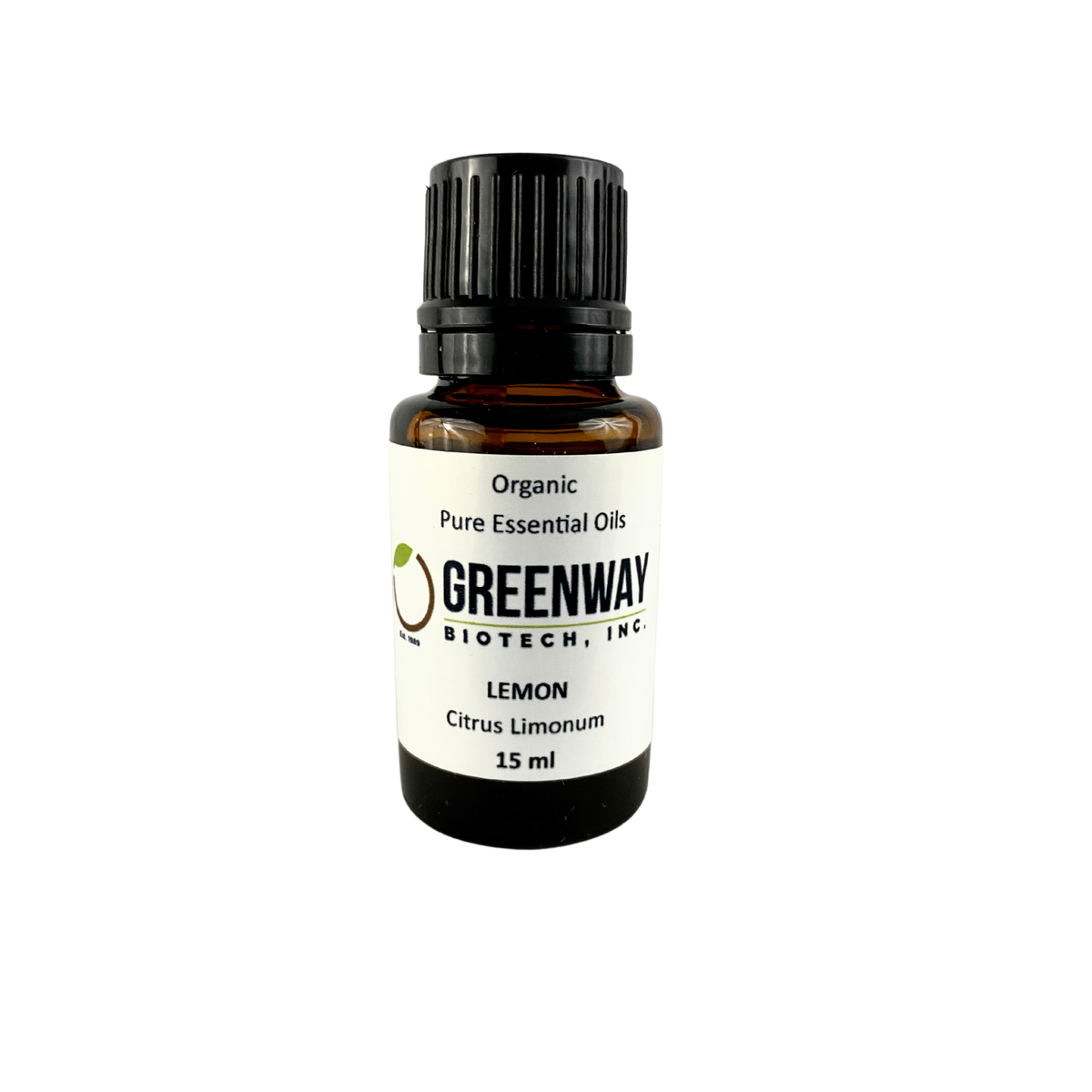
100% pure organic Citrus limonum oil, cold-pressed from organically-grown Italian lemon peels and hand-bottled in California. A bright, sharp top note for aromatherapy diffusing, DIY skincare blends, natural cleaning sprays, and roller-bottle perfumery — rich in limonene (60-70%) and protected in a 15 ml dark amber glass bottle.
Find your size → See how to use itShips from California · 90-day guarantee · GC/MS available on request
100%
Pure organic Citrus limonum
15ml
≈ 300 drops per bottle
60-70%
Limonene — the headline compound
12hr
UV avoidance window after topical use
Cold-pressed citrus oils have shorter shelf lives than steam-distilled oils — lemon is best used within 1 to 2 years of opening. Refrigerate after about three months to push to the longer end of that window.
| Size | Typical Duration | Uses per Bottle | Best For |
|---|---|---|---|
| 15 ml dark amber glass | 1-2 years opened (refrigerated after 3 months) | ~300 drops | Best starter size |
| Product Type | Single-origin cold-pressed citrus essential oil |
|---|---|
| Size | 15 ml (≈ 300 drops) dark amber glass with euro dropper cap |
| Key Ingredient | Lemon Peel Oil (Citrus limonum, syn. Citrus limon) |
| Source / Origin | Certified-organic lemon groves in Italy |
| Grade / Purity | 100% pure, certified organic, GC/MS verified — no fillers, no carrier oils, no synthetic fragrance |
| Aroma | Bright, sharp, clean citrus — fresh lemon peel with a slightly sweet undertone |
| Aromatic Note | Top note — high volatility; delivers the immediate opening impression in blends |
| Extraction | Cold pressing (expression) from fresh lemon peels |
| Phototoxic | Yes — avoid direct UV exposure for 12 hours after topical use |
| Max Topical Dilution | 2% per IFRA phototoxicity limits (~12 drops per ounce of carrier oil) |
| Storage | Refrigerate after 3 months; replace within 1-2 years. See Safety section below for full guidance. |
Lemon earns its workhorse reputation in aromatherapy, skincare blends, natural cleaning, and DIY beauty — anywhere a bright top note adds energy to a routine.
Three to five drops in a diffuser. The fresh, sharp citrus aroma is popular for morning, kitchen, and workspace diffusing.
One to two drops per tablespoon of carrier oil for the face. Skip morning use on sun-exposed skin — apply at night and follow the 12-hour UV window.
Four to six drops per ounce of carrier oil — within the 2% maximum topical limit. Pairs well with lavender for a balanced citrus-floral massage blend.
Ten to fifteen drops per 16 oz spray bottle with vinegar and water. Limonene is a well-known natural degreaser; the fresh aroma deodorizes as it cleans.
One to two drops added to your existing lotions, body washes, shampoos, or unscented base products for a fresh citrus boost.
Cold-pressed peel oil from Italian lemon groves — the source region that defines the global standard for the species. Free of fillers and synthetic fragrance, packaged in dark amber glass to keep its bright character intact.
Cold-pressed from organically-grown lemon peels in Italy — the southern European citrus belt that defines the global premium standard for Citrus limonum. Sicilian and Calabrian lemon groves in particular produce oils with brighter, more sharply expressive aroma profiles than lemon from drier or hotter regions. Domestic-to-Europe transit time also stays relatively short, which matters for an oil that oxidizes faster than most.
Mechanical cold pressing of the fruit peel — the same extraction method used for orange and grapefruit oils. No heat, no solvents. Cold pressing preserves the full spectrum of volatile aromatic compounds, capturing the true scent of fresh lemon zest rather than a heat-altered or solvent-residue profile.
Limonene makes up 60-70% of lemon oil, the most studied compound across the citrus family. It carries the bright, fresh citrus character and the practical solvent and degreasing reputation that makes citrus oils popular in DIY cleaning. The remaining 30-40% rounds out the body: γ-terpinene, β-pinene, citral (geranial + neral), and α-pinene give lemon its sharper, slightly sweet, distinctively lemony character — different from orange's roundness or grapefruit's bitter-sweet edge.
Lemon's IFRA maximum topical dilution is 2% — meaningfully lower than orange (2.5%) or pink grapefruit (4%), because it carries higher concentrations of the UV-sensitizing furanocoumarins. The 12-hour UV avoidance window applies at any topical concentration. Translation: lemon's topical headroom is narrower than other citrus, and the sun-window matters more.
Each batch is independently analyzed by GC/MS to verify the constituent profile (limonene, γ-terpinene, β-pinene, citral, α-pinene) and screen for adulterants. Citrus oils are commonly cut with synthetic limonene or with other citrus species — third-party verification matters here. Lot-coded for traceability.
Pressed in Italy, hand-filled and inspected at our family-owned Madera, California facility — registered with the FDA. One to two year shelf life when stored properly (longer if refrigerated). Backed by a 90-day money-back guarantee on every bottle.
60-70% limonene
The monoterpene that anchors all expressed citrus oils
Lemon essential oil is dominated by (R)-(+)-limonene, a monoterpene that makes up 60-70% of the oil. Limonene is the bright, fresh citrus note you smell across every expressed citrus oil — orange, grapefruit, lime, bergamot, lemon all share it as their dominant compound. Limonene is also the compound primarily responsible for the well-documented natural solvent and degreasing activity of citrus oils — the reason cold-pressed citrus oils show up in so many DIY cleaning sprays.
What gives lemon its distinct, sharper character — different from sweet orange's warmth or pink grapefruit's bitter-sweet — is the supporting cast. Citral (a mixture of two stereoisomeric aldehydes, geranial and neral) at trace levels carries the unmistakably "lemon" signature; this is the same compound that defines lemongrass oil's character. γ-Terpinene (10-15%) adds a slightly herbal-piney background. β-Pinene (5-15%) contributes a fresh, woody-resinous undertone. α-Pinene rounds out the lower-volatility tail.
Two practical implications follow. First, the oil is phototoxic — cold-pressed citrus peel oils contain trace furanocoumarins (notably bergapten) that bind to skin and cause UV-sensitized reactions. Lemon's furanocoumarin content is higher than orange's, which is why its IFRA topical maximum is lower. Second, that limonene- and citral-rich composition means the oil oxidizes quickly in the presence of air, light, and heat — and oxidized citral can sensitize skin. Both are real, both are manageable, and both are why this page repeats the 12-hour UV window and the refrigerate-after-3-months guidance more than once.
Constituent ranges below reflect typical batch profiles for cold-pressed Italian Citrus limonum peel oil. The current-batch GC/MS report is available on request.
The dominant monoterpene of all expressed citrus oils. Responsible for the bright citrus character and the practical solvent and degreasing activity. Lemon's limonene content is lower than grapefruit's (88-95%) but higher than most non-citrus oils.
A monoterpene with a slightly herbal-piney character. Contributes to lemon's "sharper than orange" reputation; significantly more prominent here than in sweet orange (where it's a trace component).
A monoterpene with a fresh, woody-resinous undertone — also found in pine and rosemary. Adds aromatic depth that distinguishes lemon from purely sweet citrus oils.
A mixture of two stereoisomeric monoterpene aldehydes. Present in trace amounts but carries a disproportionate share of the aromatic identity — citral is the compound primarily responsible for the unmistakably "lemon" smell across many other plants (lemongrass, lemon myrtle, lemon balm).
A monoterpene found across many conifers and herbs. Rounds out the lower-volatility tail of lemon's aromatic profile with a faint pine-forest undertone.
Including bergapten and other related compounds. These trace coumarin derivatives are responsible for lemon's phototoxicity profile — they bind to skin proteins and create UV-sensitized reactions. Cold-pressed peel extraction captures them; steam-distilled lemon oil would not.
| Botanical Name | Citrus limonum Risso (syn. Citrus limon (L.) Osbeck) |
|---|---|
| Common Names | Lemon, Italian Lemon |
| Plant Part Used | Fruit peel (rind) |
| Extraction Method | Cold pressing (expression) |
| Country of Origin | Italy (certified organic) |
| Grade | 100% pure, certified organic, GC/MS verified |
| Color & Appearance | Pale yellow to deep yellow, mobile liquid |
| Aroma Profile | Bright, sharp, clean citrus — fresh lemon peel with a slightly sweet undertone |
| Aromatic Note | Top note (fast-evaporating, high volatility) |
| Primary Constituent | (R)-(+)-Limonene (60-70%) |
| Signature Compound | Citral — geranial + neral (trace; carries the unmistakable lemon aromatic identity) |
| Net Volume | 15 ml (≈ 300 drops) |
| Container | Dark amber glass bottle with euro dropper cap and tamper-evident seal |
| Phototoxicity | Yes — IFRA-restricted; 12-hour UV-avoidance window after topical use |
| Maximum Topical Dilution | 2% per IFRA (Tisserand & Young, 2014) |
| Shelf Life | 1-2 years; refrigerate after 3 months to maximize |
| Packaged At | Greenway Biotech facility, Madera, California |
| Testing | Third-party GC/MS verification per batch; lot-coded for traceability |
Three primary use methods. Topical drop counts below stay within the IFRA 2% maximum from Tisserand & Young (2014). After any skin application, avoid direct sunlight for 12 hours.
Quick answer: 1-2 drops per tablespoon of carrier oil for face (~1%); 4-6 drops per ounce (about 2 tablespoons) for body (~1.5-2%). Patch test first. After any topical use, avoid sun for 12 hours.
| Use | Lemon Drops | Carrier Volume | Approx. Dilution |
|---|---|---|---|
| Facial serum (nighttime use) | 1-2 drops | 1 tbsp (15 ml) | ~0.5-1% |
| Body oil / massage blend | 4-6 drops | 1 oz (30 ml) | ~1.5-2% (max) |
| Scalp pre-wash treatment | 4-8 drops | 2 tbsp (30 ml) | ~1-1.5% |
| Add to existing moisturizer | 1-2 drops | 1 oz cream/lotion | ~0.2-0.3% |
| DIY body wash / shampoo | 10-20 drops | 8 oz unscented base | ~0.2-0.4% |
Phototoxic — read carefully: after topical use, avoid direct sunlight, tanning beds, UV lamps, and steam rooms for 12 hours on the application area. Phototoxic reactions can be severe: hyperpigmentation, blistering, sunburn-like burns. If you need a non-phototoxic citrus oil for morning skincare, use Sweet Orange Essential Oil instead. Suitable carriers: jojoba (excellent for face — closely resembles skin's sebum), rosehip seed (facial serums), sweet almond (body massage), fractionated coconut (roller bottles). Patch test on the inner forearm and wait 24 hours before broader use.
Quick answer: 3-5 drops in a diffuser for medium rooms; 6-9 drops in a 10 ml roller bottle for daytime perfume (~3% blend). Diffusing is not phototoxic; topical roller use is.
| Method | Lemon Drops | Duration / Base | Notes |
|---|---|---|---|
| Small room diffuser | 2-3 drops | 20-30 min | Bathroom, closet, small office |
| Medium room diffuser | 3-5 drops | 30-60 min | Bedroom, office, kitchen |
| Large room diffuser | 5-7 drops | 40-60 min | Living room, open kitchen |
| Tissue / cotton-ball inhalation | 1-2 drops | As needed | For on-the-go aromatherapy |
| Roller-bottle perfume | 6-9 drops | 10 ml carrier oil | ~3% blend; observe 12-hr UV window on application areas |
Starter morning blend: 3 drops Lemon (top) + 2 drops Peppermint (top) + 2 drops Rosemary (middle). Diffuse 30 minutes — popular for morning routines and workspace freshening.
Quick answer: 10-15 drops per 16 oz spray with vinegar and water.
Deep-clean variation: 5 drops Lemon + 3 drops Tea Tree + 2 drops Eucalyptus in your standard 16 oz vinegar-and-water spray. A crisp, fresh-smelling DIY cleaning blend for kitchen and bathroom surfaces.
Lemon has two things to track that most EOs don't: aggressive oxidation kinetics and a strict UV-avoidance window after topical use. Four habits make this oil pleasant to keep around.
Mix 1 drop of lemon in 1 tablespoon of carrier oil. Apply a small amount to the inner forearm and wait 24 hours. If no redness or irritation appears, the dilution is workable for you. Re-test if you take an extended break and return to the oil — oxidized lemon oil can irritate skin that fresh oil didn't.
Lemon oxidizes faster than most citrus oils due to its high citral content. Plan to refrigerate by month 3 if not sooner. Properly stored, the oil holds for 1-2 years. If the aroma turns harsh, sharp, or chemical-smelling, the oil has oxidized — discontinue topical use (oxidized citral can sensitize skin). Diffusing oxidized oil is still safe but the aroma won't be pleasant.
After applying to skin (massage, facial serum, roller-bottle perfume), avoid direct sunlight, tanning beds, UV lamps, and steam rooms for at least 12 hours on the application area. Phototoxic reactions can cause hyperpigmentation, blistering, and severe sunburn-like burns. Diffusing is not phototoxic — only direct skin application is.
Lemon essential oil is for external use only. It is not the same as lemon extract or lemon zest. Essential oils are extremely concentrated — roughly 75 lemons go into a single 15 ml bottle — and the concentrated compounds can irritate the digestive tract and mucous membranes. For culinary lemon flavor, use lemon juice, zest, or food-grade lemon extract.
Lemon is a top note — bright, immediate, fast-fading. For diffuser blends or roller-bottle perfumes that hold structure across a full session, pair with a middle note (lavender, rosemary, geranium) and a base note (patchouli, vetiver).
The dark amber glass bottle shields against UV light, the main cause of EO oxidation. Air exposure is the other main cause — keep the cap tight when not in use, and don't decant into a larger bottle that leaves a lot of headspace.
For aromatherapy use. Dilute before topical application. Avoid sun exposure for 12 hours after topical use. Keep out of reach of children. Essential oils are not intended to diagnose, treat, cure, or prevent disease.
Cold-pressed citrus oils share family resemblance but differ in aroma sharpness, phototoxicity status, and topical limits. This is how Greenway's citrus options stack up.
| Oil | Aroma | Extraction | Phototoxic | Max Topical | Best For |
|---|---|---|---|---|---|
| Lemon (this product) | Bright, sharp, clean | Cold pressed | Yes — 12 hr UV | 2% | Cleaning blends, daytime diffusing, kitchen freshening |
| Sweet Orange | Warm, sweet, rounded | Cold pressed | No | 2.5% | Daytime skincare, child-friendly diffusing, mood-lifting |
| Pink Grapefruit | Fresh, tangy, bitter-sweet | Cold pressed | Yes — 12 hr UV | 4% | Energy, mood, skincare; broader topical headroom |
| Lemongrass | Herbal-citrus, grassy | Steam distilled | No | 0.7% | Massage, deodorizing, scalp blends |
Honest sorting — lemon is a workhorse, but it isn't the right pick for every routine.
A bright top note works best alongside a balancing middle and a grounding base. These four make the most-reached-for partners for lemon across diffusing, perfume, and cleaning blends.
The classic floral middle note to balance lemon's sharpness. Together they create a calming-yet-uplifting blend for evening diffusing or pillow-spray bedtime routines.
Essential OilCooling top-note partner. Lemon + peppermint is a popular morning diffuser blend for workspace freshening and clear-air aromatherapy.
Essential OilA cleansing middle note. The standard DIY-cleaning companion to lemon — both are limonene/terpinene-rich and well-suited to natural surface sprays.
Essential OilWarm, sweet citrus depth alongside lemon's sharper character. Sweet orange is also non-phototoxic — a useful daytime alternative if you can't observe the UV window.
Lemon has a real phototoxicity profile and faster oxidation kinetics than most EOs. Neither is minor; both are manageable with the habits below.
If your question isn't here, contact our team at questions@greenwaybiotech.com.
Yes. Our lemon essential oil is 100% pure, certified-organic Citrus limonum (syn. Citrus limon). It contains no synthetic additives, fillers, fragrance oils, or carrier oils. It is cold-pressed from organically-grown Italian lemon peels and hand-bottled at our family-owned Madera, California facility.
Cold expression (cold-pressing) is a mechanical extraction method that punctures or grates the lemon peel and collects the released oil — no heat, no chemical solvents. The result preserves the full range of naturally occurring volatile compounds (limonene, citral, terpinene, pinenes) and captures the true scent of fresh lemon zest. The trade-off is that cold-pressed citrus oils also carry the trace furanocoumarins responsible for phototoxicity; steam-distilled lemon is not phototoxic but smells noticeably different.
No — lemon oil must be diluted with a carrier oil before any topical use. The IFRA maximum topical dilution is 2%: roughly 1-2 drops per tablespoon of carrier oil for the face, or 4-6 drops per ounce of carrier oil for body blends. Undiluted application can cause skin irritation. Lemon is also phototoxic, so any skin application requires avoiding direct sunlight for 12 hours.
Lemon oil contains trace furanocoumarins (notably bergapten) — compounds that bind to skin proteins and react with ultraviolet light, causing severe sunburn-like burns, blistering, or lasting hyperpigmentation. This is called phototoxicity, and it's common across cold-pressed citrus peel oils including lemon, bergamot, lime, and pink grapefruit. If you apply lemon oil to skin, avoid direct sunlight and tanning lamps for at least 12 hours on the application area. Sweet Orange oil is the notable exception — it's non-phototoxic.
Not directly. Essential oils don't mix with water, so drops added to a bath float on the surface undiluted and can irritate skin, and bath salts, Epsom salt and milk don't disperse them. Enjoy Lemon in a diffuser instead.
Store in a cool, dark place with the cap tightly sealed (air is the main oxidation driver). Lemon oxidizes faster than many essential oils due to its high citral content — plan to refrigerate by month 3 if not sooner. Properly stored, shelf life is 1-2 years. Let refrigerated oil reach room temperature before use — cold oil flows slowly through the dropper. If the aroma turns harsh or chemical-smelling, discontinue topical use; oxidized citrus oil can sensitize skin.
For garden insect control specifically, we recommend using a properly formulated product like our Buzz Away Bug Repellent rather than DIY essential-oil sprays on plants. DIY essential-oil applications on plants don't carry standardized concentrations and can cause leaf burn at higher dilutions, particularly under summer sun. Pesticide and insecticide claims for plant use also require federal (EPA/FIFRA) registration, which our straight essential oils don't carry. Lemon's primary kitchen uses are aromatherapy, DIY cleaning, and skincare blends — not plant treatment.
Use caution. Cats are particularly sensitive to citrus essential oils — they lack the liver enzymes needed to metabolize many essential-oil compounds, and citrus oils are among the more problematic for them. Dogs are generally less sensitive but can still react to concentrated exposure. If diffusing lemon oil, ensure your pet can leave the room freely. Never apply essential oils directly to a pet's fur or skin without veterinary guidance.
Fractionated coconut oil and jojoba oil are our top recommendations — both are lightweight, absorb well, and have minimal scent that lets the lemon aroma come through. Sweet almond is another solid choice for body massage blends. For facial use, jojoba is ideal because its molecular structure closely resembles the skin's natural sebum, promoting absorption without clogging pores.
No. Our essential oils are formulated and labeled for external aromatherapy use only. Essential oils are extremely concentrated — roughly 75 lemons go into a single 15 ml bottle of cold-pressed peel oil. While lemon juice and zest are safe to consume, the concentrated compounds in the essential oil can irritate the digestive tract and mucous membranes. Essential oils are not intended to diagnose, treat, cure, or prevent disease.
Lemon essential oil is extracted from the peel by cold expression and is highly concentrated — intended for external use only (aromatherapy, skincare blends, natural cleaning). Lemon extract is a food-grade product, typically made by soaking lemon peel in alcohol, and is safe for cooking and baking. They are not interchangeable. Never use essential oil as a food flavoring; never use food-grade lemon extract for aromatherapy diffusing (the alcohol carrier is not suitable for diffusers).
One 15 ml dark amber glass bottle. Cold-pressed from certified-organic, Italian-grown Citrus limonum peels; hand-filled in Madera, California. Free shipping on orders over $100 in the continental US, and a 90-day money-back guarantee.
Choose your size →Ships from California · 90-day guarantee · GC/MS reports above